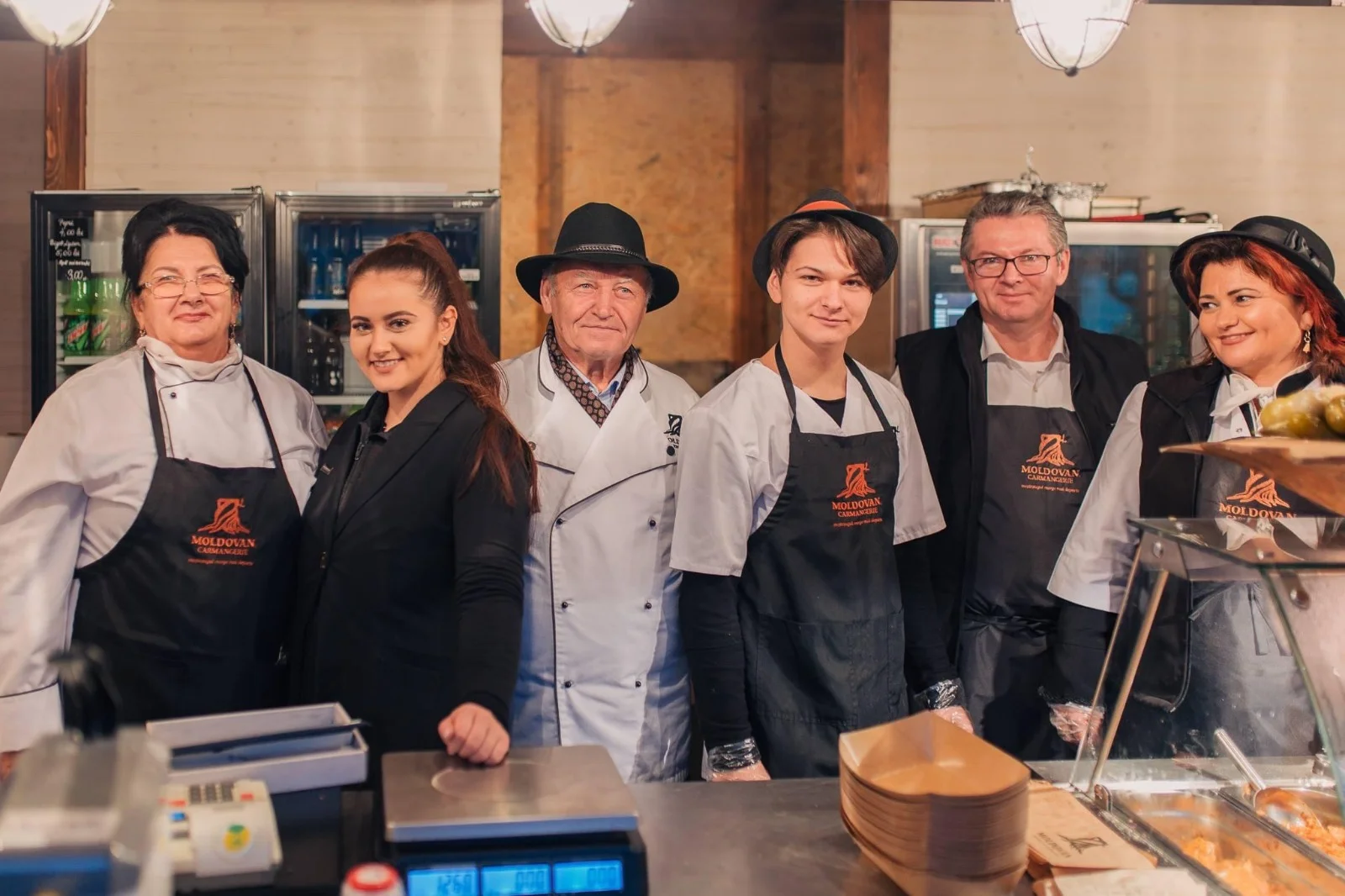
Angela Moldovan, on the road from the garage where it all began to a company that feeds Transylvania
Now, at 77, my mornings are quieter than they have ever been. I pour my coffee into my white cup, settle into the chair that has, over time, taken the shape of my body, and let the memories flow, one by one. It is the only time of day when I do not have to hold anyone up, to comfort, to build, to make peace. It is my hour of peace. The hour in which I finally let myself breathe and return to myself and to all that I have lived.
For a few years now I have started travelling often. Three, sometimes four trips a year, all with my friends. In a few months I hope to reach Norway. I want to see the fjords, tall, sheer mountains and waters that pass calmly between them, cutting their path in spite of every obstacle in their way. Perhaps that is why I feel their call: that is how I see our family too. It has moments when it wavers, when it goes through storms, but it always finds its way forward. Perhaps I too am looking there, among the fjords, for a kind of continuity that I no longer feel every day at home.
If you ask me where I got this taste for the road and for the world, I do not know myself. But I believe I was always a brave woman. Without courage, I would never have thrown myself alongside my husband into a business born out of nothing, in times when we did not know whether we would make it to the next day.
I always stayed behind the curtain. Not because I had nothing to say or because I could not do it, on the contrary, I had my say and I said it when it was needed. But my role was a different one: to support my boys. To create an atmosphere that let them work in peace. To put a warm dinner on the table after a hard day. To lift them up when they felt worn down by exhaustion.
What many people do not know is that, before we all stepped into the world of meat, I worked for years at the CFR public health service; I was an assistant in Food Inspection. There I learned the real rules of the trade: what cleanliness means, what safe food means, what responsibility toward the people who eat what you produce means.
That knowledge, seemingly simple, practical, sometimes wearing, became the greatest value I brought to our business. Because I would never have let anything leave the gate that I would not have given to my own children.
I had no office, no title. But I was always present, in every decision, in every moment of fear or hope.
My husband, Bibi, was the first to dream of a business. Those were the years after communism, when the market was only just forming and we were learning as we went, the hard way. Everything was built on trial. On instinct. On improvisation. On "let's see if we can."
In that small garage, I remember how he would say to me: "Let us never be ashamed of what we put on the table." That was our golden rule. No compromises. "If you would not eat what you produce, it is not worth selling," he always said.
There, in the cold of that first winter, we fed the people who raised our first factory. I cooked for them with the same care with which I cooked for my own family. And I believe that is where the essence of Carmangeria Moldovan lies: first we fed our own people, then we fed the world.
That is why, when I walk into the shops today and catch that smell of fresh, clean meat, made the way Bibi taught me, I feel that something of our beginnings is still kept. It is the taste of Cosmin's childhood. The taste of the years when honest work was our only currency. The taste of our simple, honest Transylvania.
Carmangeria Moldovan is not just a company. It is our third home. It grew alongside us, with our joys, our quarrels, our reconciliations. It is part of the family, but also part of the town. Part of the people who cross our threshold and know that with us they will find quality, fairness, and heart.
Then it was Cosmin's turn, our boy. He did not learn the trade from books, but straight from practice. Beside his father, in the factory, in the shops, on the road. He picked up everything: the raw work, the enthusiasm, the responsibility, and the risk.
I remember how his eyes shone when he spoke of the future: "More beautiful, mother... bigger... better." And I always told him: "Go, but never forget where you started from."
Between my two men, Bibi, traditional and careful, and Cosmin, visionary and impatient, I was the bridge. When they argued, I knew it would not divide them. Their conflicts were productive. That is how they were: two forces from which something good was born.
When Cosmin married, I welcomed his wife with open arms. It is not easy to step into a family business, the rules are not written down, but they exist, and the pressure is high. So I did what I knew best: I built bridges.